Polytrader.

Sign Up

Enter your email and we'll send you a link.

Polymarket · daily brief

You're the exit liquidity. Stop being it.

We read the tape overnight — order books, on-chain flow, the news the crowd is mispricing — and email you a five-minute brief at 7am ET naming the markets to fade, the ones to follow, and the ones to skip. Built for the 84% of Polymarket accounts losing money, not the 3% who'd rather you didn't read this.

No app. No Discord. One email at 7am ET. Free for the first cohort.
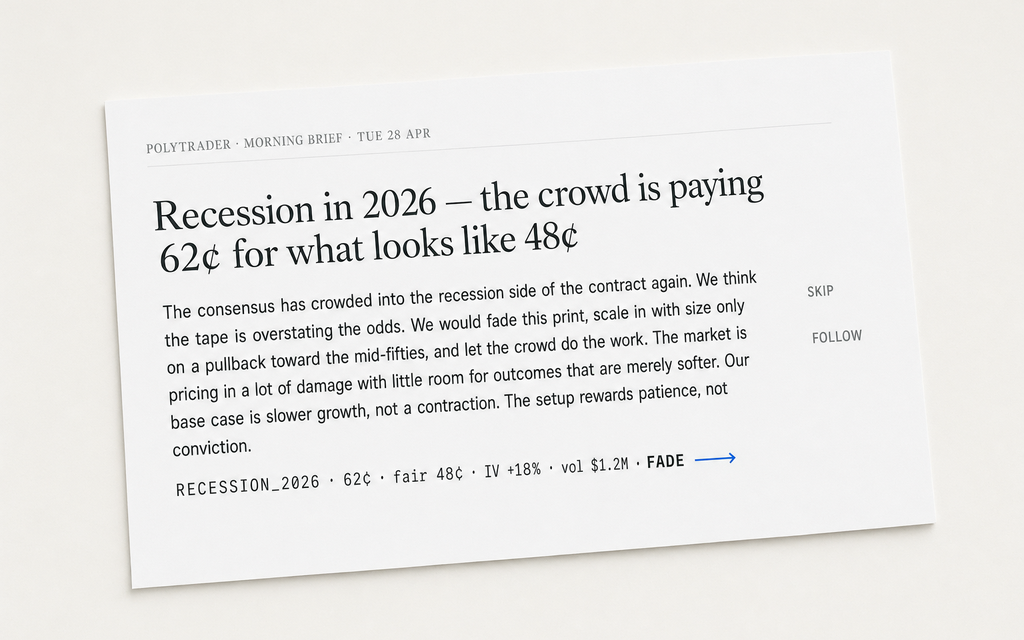
A printed Polytrader morning-brief page lying on a clean desk: serif headline reading 'Recession in 2026 — the crowd is paying 62¢ for what looks like 48¢', dense editorial body, a monospace data callout for RECESSION_2026 with the word FADE underlined in electric blue.

01 · the workflow you already have

How you got here

You bought $RECESSION_2026 at 62¢ at 11:47pm because someone in a Discord said the print on Friday was going to be ugly, and a YouTube guy with a ring light agreed, and your friend on WhatsApp had screenshotted his position and it was up 14% and the trade looked obvious. By Tuesday it was 51¢. By Friday it was 44¢ and you closed the tab. Nobody was lying to you, exactly — they just happened to be holding the bag they wanted to hand you, and you were the next person willing to take it. That is what exit liquidity is. That is what you have been, for the past nine months, every time the trade looked obvious.

84%
of Polymarket accounts lose money (crypto.news, public on-chain analysis)
3%
are net positive over twelve months (same dataset)
$0
spent so far on tooling actually written for the loser

02 · the workflow we propose instead

How it works

  1. Step 1

    We read the tape.

    Order books, on-chain whale flow, news cycle, base rates from prediction-market history — every night, while the crowd is asleep and the price is drifting on volume that doesn't know anything yet.

  2. Step 2

    You read for five minutes.

    One email at 7am ET, dense, no charts, no upsell, no Discord — every market we name comes with a fair-value number and a reason, not a vibe.

  3. Step 3

    You fade, follow, or skip.

    Every call we publish goes into a public miss-log, scored weekly, kept honest, so you can decide whether to keep listening or stop.

03 · what's in the brief

What you get every morning.

Fair value, with the receipts.

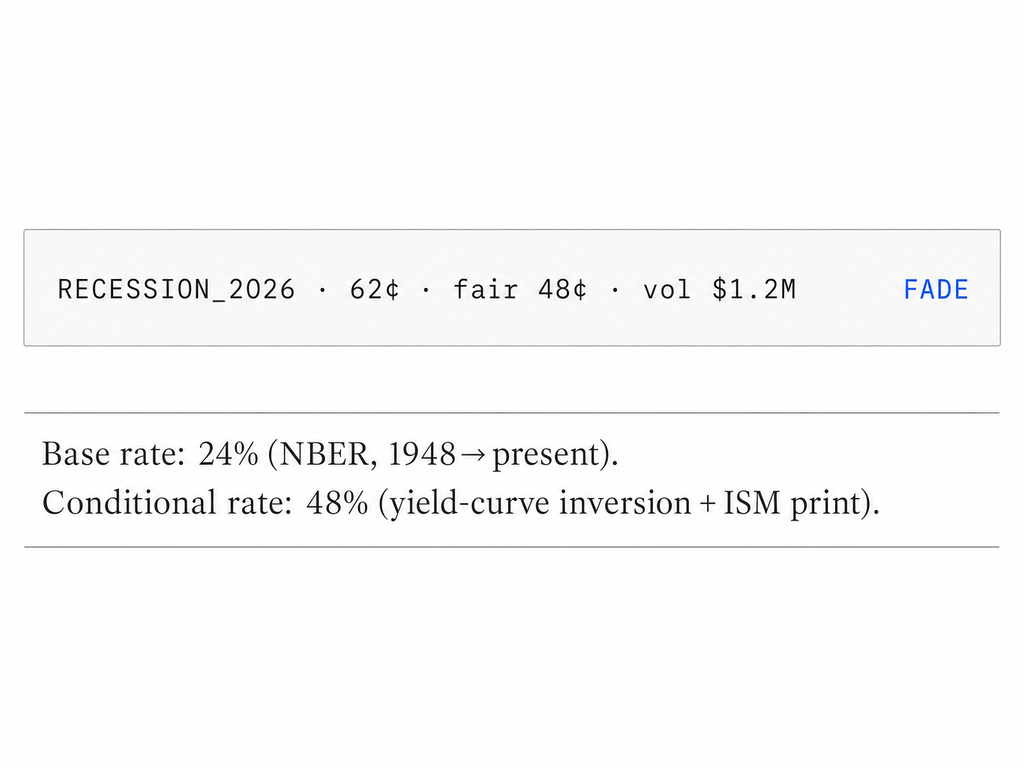
Every market gets a fair-value number sourced from base rates, recent comparables, and whatever the sharps are doing — written down, not vibed. When the crowd price is 14¢ above fair, we say "fade", and we show the math we used to get there.

Sample brief panel showing RECESSION_2026 at 62¢, fair value 48¢, with a one-paragraph base-rate adjustment and a 'size: half-unit' footer.

A miss-log you can audit.

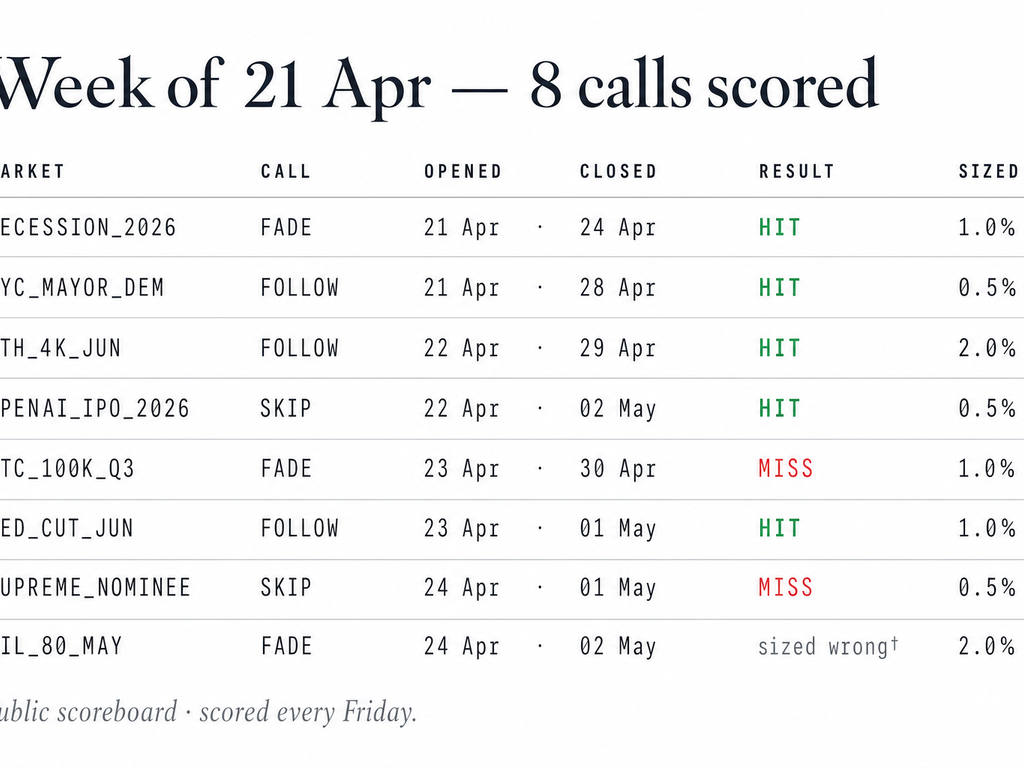
Every call goes onto a public scoreboard — wins, losses, and the ones we sized wrong. You can see the hit rate before you trust the next one, instead of taking someone's screenshot of their best week.

Public weekly scoreboard table — 12 rows of past calls, market name in mono caps, our take, our size, the resolved outcome, and a green/red/sized-wrong pill.

Sized for your bankroll.

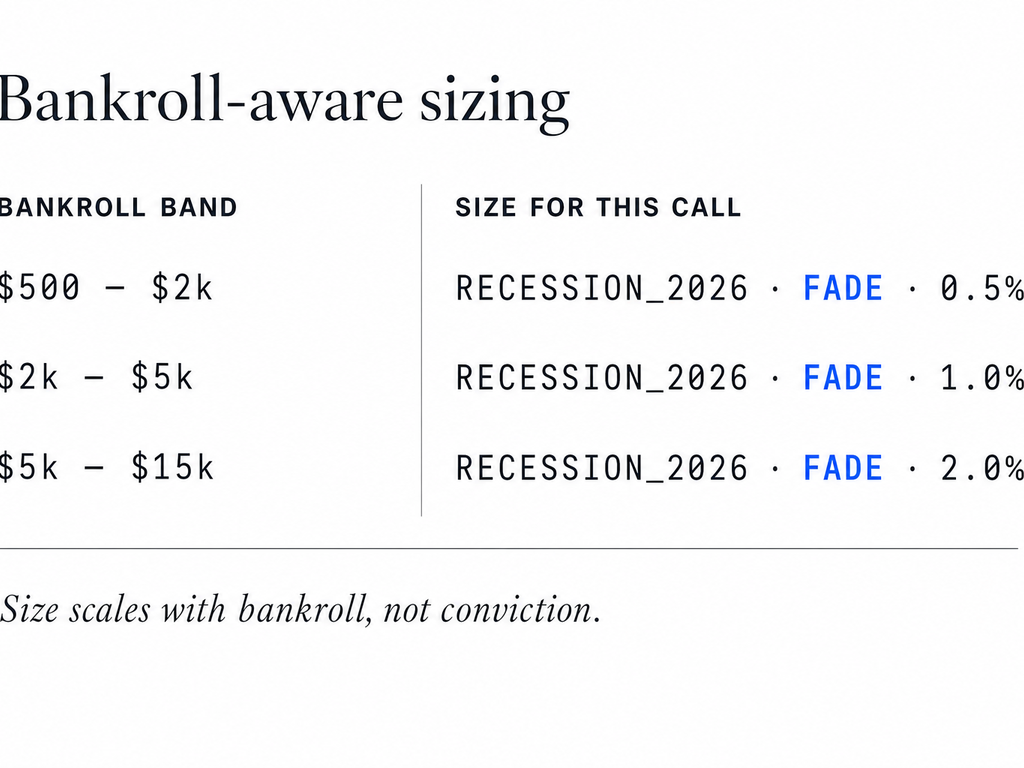
Each call comes with a size instruction calibrated to the money you're actually playing with — half a unit at $1k, a quarter at $10k, sit it out below a confidence threshold. Conviction is not a position size.

Two-column sizing table showing bankroll bands — $500-$2k vs $5k-$15k — with explicit unit fractions (0.5u, 0.25u, skip) for three example markets.

Five minutes, 7am, inbox.

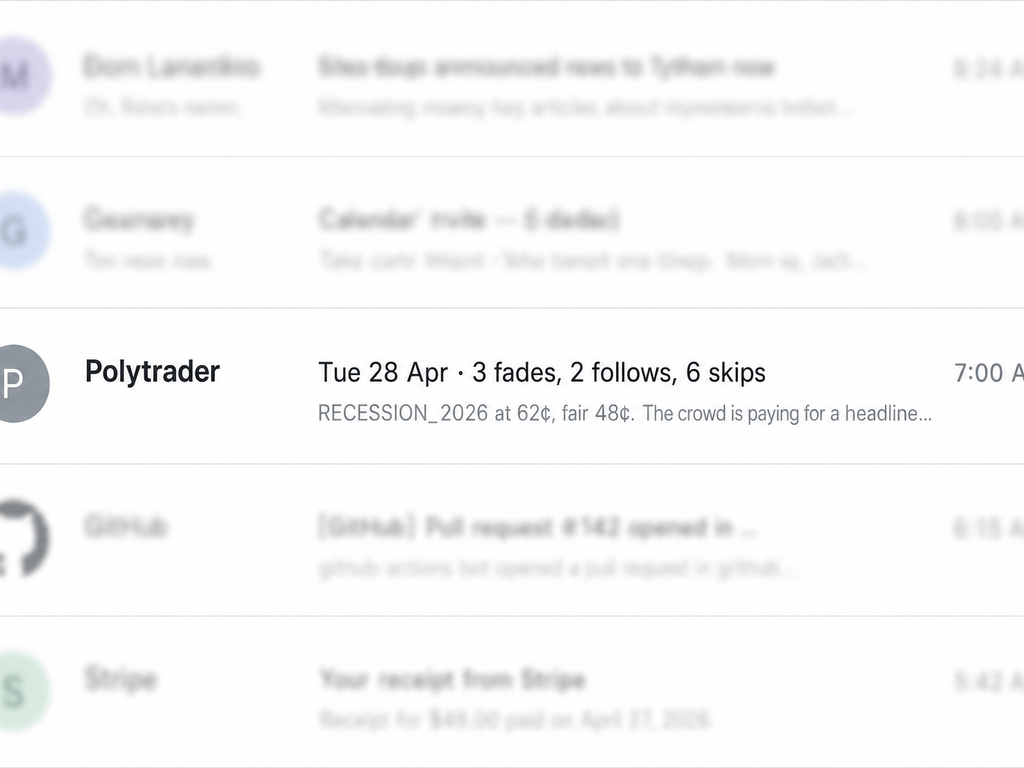
One email a day. No Discord, no charts, no upsell, no push notifications at midnight. If you can't read it before your coffee gets cold, we wrote it wrong.

Inbox view showing a single open polytrader email at 7:02am ET — Tuesday's brief with three short market sections, no banners, no sidebar, surrounding inbox rows blurred.

04 · what changes

What you stop doing.

05 · proof

The math, not the vibes.

Most of these readers were in the 84% before they subscribed. They are not professional traders — they are people who decided that "trust me bro" was not a research process.

"I lost about $1,800 over the summer trading election markets off a Discord I shouldn't have been in. I subscribed in October mostly out of stubbornness. Three months later I'm up $640 — not because the calls are magic, but because the sizing instruction stops me from going all-in on a feeling at 1am. The brief lands in my inbox before I've decided to be reckless that day."
Marta Kowalczyk, late 20s, at her kitchen table at 1am with a hoodie and laptop glow on her face.
Marta Kowalczyk
$2.5k bankroll, 11 months on Polymarket
"Why does a fair-value number with a paragraph of base-rate math feel like a luxury? It shouldn't. They flagged FED_CUT_JUNE · 71¢ as overpriced when everyone on my timeline was buying — fair was 56¢, and that one trade paid for the year."
Aaron Mehta, mid 30s, at a sunlit home-office desk with a polo shirt and a coffee mug.
Aaron Mehta
Burned-once retail, $4k bankroll
"It's the first thing I open before I look at the actual market. The miss-log is the part that sold me — they call out their own sized-wrong trades on the same page as the wins, which is not a thing the Discord guys do."
Priya Subramanian, 30s, at a kitchen counter in morning light with a phone in one hand and a mug in the other.
Priya Subramanian
$1.2k bankroll, ACX-adjacent reader
"I already pay for Money Stuff and Slow Boring. This is the only Polymarket thing that reads like either of them."
Jonas Lindqvist, 40s, in an evening reading nook with a wool sweater, glasses, and a bookshelf behind him.
Jonas Lindqvist
Newsletter reader, Brussels
"The base-rate adjustment is what convinced me. I came in expecting a vibes newsletter and got something that distinguishes skill from variance honestly — they say out loud which calls were correct for the wrong reasons. That's not a thing most paid analysts will admit on a public page."
Alex Velázquez, 30s, at a standing desk mid-afternoon with headphones around her neck and code on a monitor behind her.
Alex Velázquez
Senior PM, ACX reader

What the brief looks like.

One morning's brief, real format, real sourcing logic — the brief that lands in your inbox tomorrow will read exactly like this.

Polytrader · Morning Brief · Tue 28 Apr sample
Recession in 2026 — the crowd is paying 62¢ for what looks like 48¢

The market is pricing a 2026 NBER-defined recession at 62¢ on $1.2M of weekly
volume, up from 54¢ ten days ago on the back of one soft ISM print and a
Bloomberg piece quoting two strategists. Base rate for a recession in any
given calendar year since 1948 is roughly 24%; the conditional rate given
current yield-curve and unemployment-trend inputs is closer to 48%. The
crowd is paying for a headline. We're fading, small — variance is wide and
the resolution date is far. Size accordingly, or skip.

RECESSION_2026     · 62¢ · fair 48¢ · IV +18% · vol $1.2M · FADE
TRUMP_INDICTMENT_Q3 · 31¢ · fair 34¢ · IV  -4% · vol  $480K · FOLLOW

Methodology

  • Sources read nightly: Polymarket order books, on-chain wallet flow, AP/Reuters wires, two macro newsletters.
  • Every fair-value number adjusts the crowd price against a documented base rate, not a hunch.
  • Every call goes into a public miss-log, scored weekly — wins, losses, and the ones we sized wrong.
  • We sell to the loser, not the pro: the pro doesn't need us, and we don't need to flatter them.

Tomorrow morning at 7am, you can either read the brief or check Discord. You already know which one ages better.

Start tomorrow's brief

06 · today's brief — preview

Today's brief — preview

Three tabs. The same brief you'll get tomorrow at 7am, sliced by what to do with it.

RECESSION_2026          · 62¢ · fair 48¢ · vol $1.2M  · FADE
GPT5_BY_AUG_2026        · 71¢ · fair 55¢ · vol  $640K  · FADE
FED_CUT_JUNE            · 44¢ · fair 36¢ · vol  $890K  · FADE — small

Three markets, one theme: the crowd is paying for the headline, not the
distribution. The Fed cut is the cleanest of the three; the GPT-5 line is
the one most likely to drift further before it corrects.

View full reasoning → — the full reasoning ships in tomorrow's brief.

07 · sign up

Get tomorrow's brief.

Tomorrow at 7am ET, the next brief lands in your inbox. Five minutes, dense, free for the first cohort.

Trade with the math, not the megaphone.

Read the methodology →

Or get tomorrow's brief →